D Design style guide
Arabic Style Interior Design: Materials, Patterns and Modern Applications.
Arabic style interior design combines sheltered comfort, crafted surfaces, rhythmic ornament and warm, layered light. A convincing room does not need every traditional motif at once. It needs a clear spatial idea, a disciplined material palette and details chosen with respect for their cultural and architectural context.
Arabic style interior design at a glance
Compose the room
Start with enclosure, shade, symmetry and a social center. Architectural rhythm should lead; accessories should complete it.
Control the detail
Choose one main family of geometry, foliage or linear ornament, then vary its scale across selected surfaces.
Make it current
Pair crafted materials with restrained furniture, quiet walls and practical lighting so heritage references remain clear without feeling staged.
Style principles: what defines Arabic style interior design?
Arabic style interior design is a broad design family rather than one fixed historical formula. Homes across North Africa, Egypt, the Levant and the Arabian Peninsula developed distinct responses to climate, craft traditions and patterns of hospitality. The useful contemporary approach is to study the principles behind those interiors instead of treating regional details as interchangeable decoration.
The first principle is welcome. Grouped seating supports conversation and shared use. The second is transition. Screens, niches, framed openings and flooring shifts can mark the passage from public to quieter areas without closing every zone. The third is visual rhythm. Repeated arches, panels or pendant forms can hold a restrained composition together.
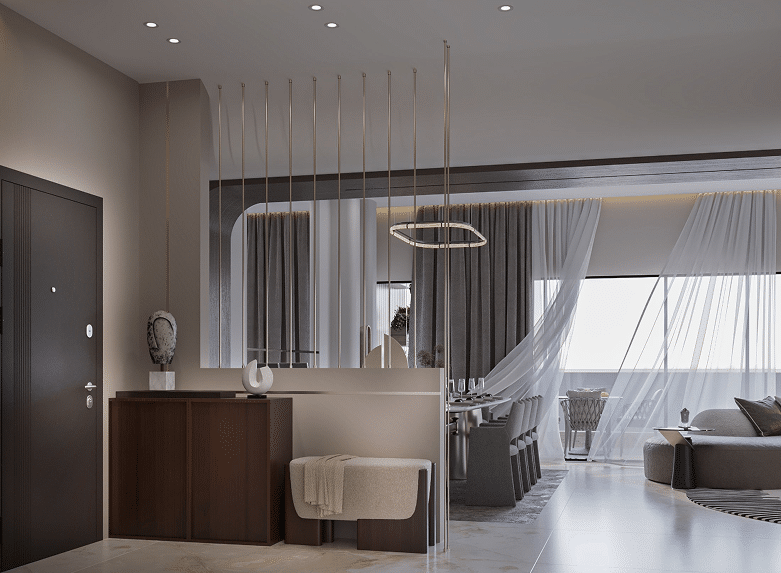
Privacy and filtered light also shape the character of the style. A perforated screen can soften a view and cast changing shadow, while curtains can give a room depth and enclosure. These elements should solve a real spatial need. Applied arches, false screens and crowded ornament feel superficial when they do not relate to the plan.
Begin with the room's behavior: where people gather, how daylight enters, which views need framing and where privacy matters. The style will feel more authentic when each decorative decision supports one of those conditions.
Patterns: how should geometric and botanical motifs be used?
Pattern works best as a system of repetition, not as a layer added to every available surface. Geometric grids can organize screens, tiles, rugs and inlay. Stylized leaves, vines and flowers bring a softer movement. Calligraphic decoration carries language and cultural meaning, so it should be understood and sourced responsibly rather than used as an abstract graphic.
The Victoria and Albert Museum's guide to Islamic tile and printed pattern explains how symmetry and tessellation create repeating compositions. That framework is useful in interiors because it turns pattern into an ordered field. A designer can echo the same underlying geometry at different scales without copying one motif everywhere.
Choose a visual anchor
Let a tiled panel, carved screen, rug or ceiling feature carry the most detailed motif. Nearby finishes can repeat its lines in quieter ways through stitching, joinery or a simple border.
Leave resting space
Plain plaster, timber or fabric gives the eye a pause and makes detailed work easier to appreciate. Contrast between ornament and calm is part of the composition.
Scale should follow distance. Fine inlay rewards close viewing, while a larger repeat reads clearly across a rug or wall. Compare the geometry, density and direction of motifs, then remove any element that competes with the chosen anchor.
Materials: which finishes create depth and authenticity?
Materials give Arabic style interior design its depth through grain, relief, reflection and evidence of making. Timber can appear in doors, screens, ceiling details and furniture. Stone supports floors, thresholds and calm wall surfaces. Plaster can form softly modeled arches, niches or carved relief. Ceramic tile introduces color and repetition, while metal adds a controlled glint through lighting, trays, hardware or inlay.
Textiles make formal architecture feel habitable. Woven rugs, linen curtains, patterned upholstery and tactile cushions soften hard surfaces. The best selections share an undertone and a level of formality. Contrasting finishes can coexist when one material bridges them.
Judge finishes as an assembled palette. Place samples beside one another in the actual room, under daylight and evening light. Timber stain may pull red beside warm stone, and a bright metal may become too dominant against matte plaster. Natural variation is part of the appeal, so samples should be treated as a guide rather than a promise of perfect uniformity.
Crafted-looking substitutes need careful review at edges, joints and repeating areas. An imitation that repeats too mechanically can weaken the room more than a simple, honest material. If custom carving or inlay is not appropriate, use clean timber, plaster and fabric with confident proportions.
Colors: how can a warm palette remain balanced?
A balanced Arabic-inspired palette starts with the permanent surfaces. Sand, limestone, ivory, clay and warm gray can form a quiet background. Deeper accents may come from burgundy, date brown, indigo, olive, teal or muted gold. These colors should respond to the room's daylight and materials rather than follow a ready-made theme.
Use saturated color where it has a clear role. A rug can ground the seating group, tile can define a niche, and upholstery can draw attention to a social area. If several detailed elements compete at equal intensity, the architecture disappears. Keeping walls and large furniture calmer allows craft and pattern to hold their place without overwhelming daily life.
Undertones matter more than exact matching. Warm white beside creamy stone feels connected, while a sharp blue-white can make the same stone appear dull. Metals also influence color: aged brass reads warmer and quieter than a mirror-bright finish. Review painted samples vertically and fabric samples in their intended folds because angle and texture change how color reads.
For a broader look at pairing contemporary planning with restrained finishes, see D Design's modern interior design guide. The same discipline applies here: a coherent base gives expressive details room to work.
Lighting: how does layered light support the style?
Lighting should reveal texture and create intimacy rather than depend on one pendant. General light supports movement. Task light serves daily activities. Accent light can graze plaster, wash tile or reveal a screen. Decorative fixtures then contribute silhouette and shadow.
Perforated metal and patterned glass can produce attractive effects, but glare and harsh shadow need testing. A fixture seen directly from a sofa or bed should remain comfortable. Light behind a screen should reveal the pattern without turning the source into a distracting bright patch. Concealed light works best when its location and reflection are hidden from normal viewpoints.
Warm-looking light usually supports timber, clay, brass and rich textiles, but all sources in a connected area should be compared together. Separate controls allow a lively gathering setting and a quieter evening atmosphere. Daylight remains part of the plan: sheer fabric, deeper curtains and filtered screens can adjust brightness while keeping the layered quality associated with the style.
Choose decorative fixtures after the furniture plan. Their centerlines should relate to tables, seating groups, corridors or architectural bays rather than to an empty ceiling plan.
Modern applications: how can Arabic style feel contemporary?
Modern Arabic style works through editing. Retain the ideas of hospitality, filtered light, crafted material and rhythmic detail, then simplify outlines and reduce the number of focal points. A contemporary room might pair a low, generous sofa with one geometric rug, a plain stone table, an elegant screen and a sculptural pendant. The reference is readable, but the room still feels open and practical.
In a living room, use a rug and seating arrangement to establish the social center, then concentrate detail behind the main focal point. In a bedroom, a recessed headboard wall, woven textile and soft pendant light may be enough. Kitchens benefit from durable plain fronts with pattern reserved for a backsplash or glazed cabinet. Bathrooms can use stone and tile to create a calm, enclosed atmosphere without adding ornamental objects.
Open-plan homes require continuity. Repeat a timber tone, metal finish or geometric line across adjoining zones, but vary the ornament by function. A detailed reception area can lead into quieter dining space through shared color and simpler lighting.
Adaptation should also respect the building. A new apartment may suit abstracted arches, slim screens and flush joinery, while an older home may support deeper profiles and more visible craft. D Design's approach to combining planning, finishes and execution is introduced on the About D Design page. Coordinating those decisions early helps the style read as part of the space rather than a final decorative layer.
Frequently asked questions about Arabic style interior design
Is Arabic style interior design the same across every region?
No. Arabic-speaking regions have distinct architectural histories, materials and craft traditions. Use a specific regional reference where possible, and avoid combining unrelated motifs simply because they share a broad label.
Can Arabic style work in a small apartment?
Yes. Focus on atmosphere instead of architectural imitation. A compact seating group, one patterned textile, warm timber, layered curtains and a carefully chosen light can communicate the style without crowding the plan.
How much pattern should one room contain?
There is no fixed amount. Choose one dominant patterned surface and support it with quieter repetitions or plain materials. If the eye cannot identify a focal point, remove or simplify competing motifs.
Are arches required for an Arabic-inspired interior?
No. Arches are one architectural reference, not a requirement. Screens, material transitions, low seating, textiles, niches and filtered lighting can express the underlying principles more naturally in a room that has no arched construction.
How can calligraphy be used respectfully?
Understand the text, language, meaning and intended placement before using it. Work with a knowledgeable artist or supplier, and avoid placing sacred or culturally significant words on floors, seating or other unsuitable surfaces.
What makes an Arabic-style room look overly themed?
Too many arches, lanterns, motifs and saturated colors at equal strength can make the room feel staged. Reduce the decorative vocabulary, keep the largest surfaces calm and let a few well-made elements carry the identity.
Official design reference: Victoria and Albert Museum, Design and Make Your Own Islamic Tile and Printed Pattern.